
How Importing Countries Can Build Energy Security Against Geopolitical Shock
In February 2026, Iran engaged in a blockade of the Strait of Hormuz, thus affecting around 30% of global crude shipping, as well as 24% of LNG and 14% of refined products. With few alternative routes, Gulf countries, which are typically the global balancing producers have seen their supply being virtually trapped. With a global imbalance between supply and demand that we estimate at around 1,000 mbl at the end of June 2026, the impact on prices has been immediate and significant, with the Brent exceeding $100/bbl for the first time since 2022.
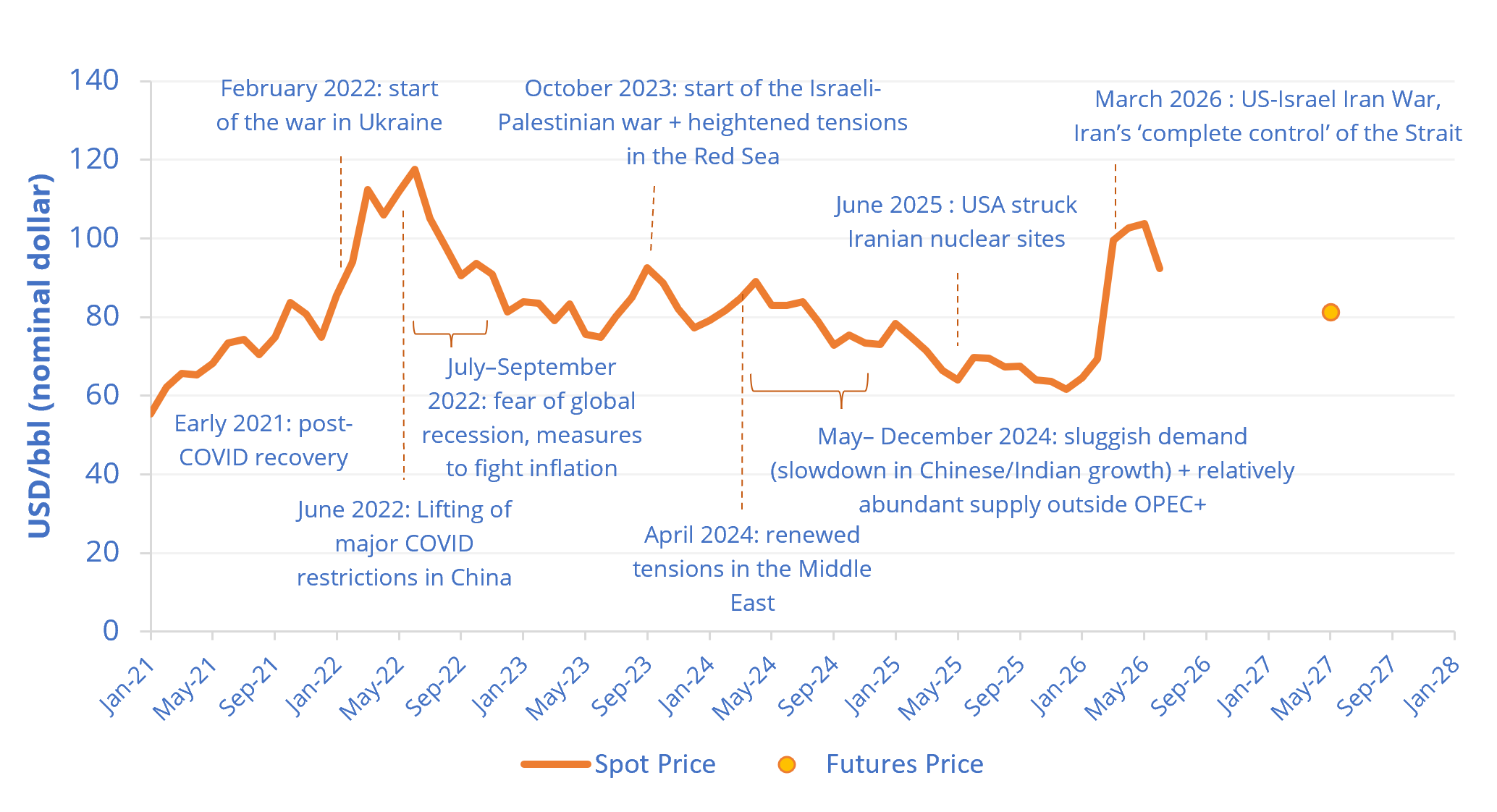
Natural gas prices in Europe have also increased by 60% in March 2026, to reach €52/MWh. They have slightly decreased and stabilized around €45-50/MWh since then but tensions on LNG markets should remain, with Asia and Europe trying to secure natural gas supply.
Consequences on end-user prices, and consumer protection measures
Oil products have been directly impacted, not only by the supply disruptions in crude oil, but also directly through the blockage. The lower availability of medium and heavy crudes also tends to affect certain products more than others, leading refineries to trade-offs between products that impact efficiency and reduce overall production. As a result, prices for oil products have also risen dramatically in Europe, with diesel and petrol prices up by 50% and 40% respectively compared to the 2025 average (net of tax).
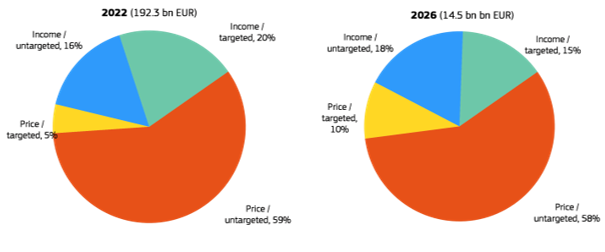
If current consumer protection measures are maintained throughout 2026, government spending is estimated to reach €39 billion, or approximately 0.2% of GDP. This is much lower than the €192 billion spent in 2022, which represented 2.1% of GDP. However, these figures mask a high level of heterogeneity among EU Member States; for instance, projected spending ranges from around 0.5% of GDP in Spain to just 0.05% in France.
As shown by Figure 2, governments have relied heavily on untargeted price-focused measures, such as cuts to VAT or excise taxes. As taxes account for between 50% and 60% of oil products prices across European countries, such measures are easy to implement and offer automatic diffusion across the economy. As of June 2026, countries like Spain for instance have heavily relied on tax cuts to almost entirely neutralize the increase in wholesale prices. Meanwhile, in France, no tax cuts have been implemented and net-of tax diesel and petrol prices increased by 26% compared to 2025.
They have however the downside of lowering the price signal for consumers. In contrast, targeted measures are directed specifically at vulnerable households or sectors exposed to international competition and thus reduce costs for more efficient results on paper. In addition, when support is delivered via income measures rather than price adjustments, it helps compensate for the loss in purchasing power while maintaining the incentive to reduce energy consumption.
Price caps are excluded from these fiscal spending calculations because they do not involve direct government spending or revenue changes; instead, they operate by redistributing producer margins.
Decarbonisation to ensure energy security in the long-term?
The real long-term pathway to reduce EU’s and overall importing countries’ dependence on fossil fuels, and the ever-reoccurring crises that come with it, seems to rely mostly on the decarbonization on energy systems.
To explore the future of global energy systems, three distinct EnerFuture scenarios are utilised. More specifically, EnerBlue (achievement of national NDCs submitted by late 2025, keeping warming between 2°C and 2.5°C), and EnerGreen (an ambitious pathway aligned with the Paris Agreement to limit warming well below 2°C) reflect a level of ambitious that leads to a profound transformation of the global energy system, with the share of fossil fuels dropping respectively to 41% and 25% in 2050 globally, from 80% historically.
Achieving these targets relies on three main decarbonisation levers:
- carbon-free electricity,
- energy efficiency,
- and sufficiency
By accelerating the electrification of final energy uses while simultaneously decarbonising power generation, the share of fossil fuels and associated CO2 emissions can be dramatically reduced while capturing substantial energy savings. In parallel, other critical levers must be mobilized, including energy efficiency measures and behavioural shifts that foster energy sufficiency and circularity.
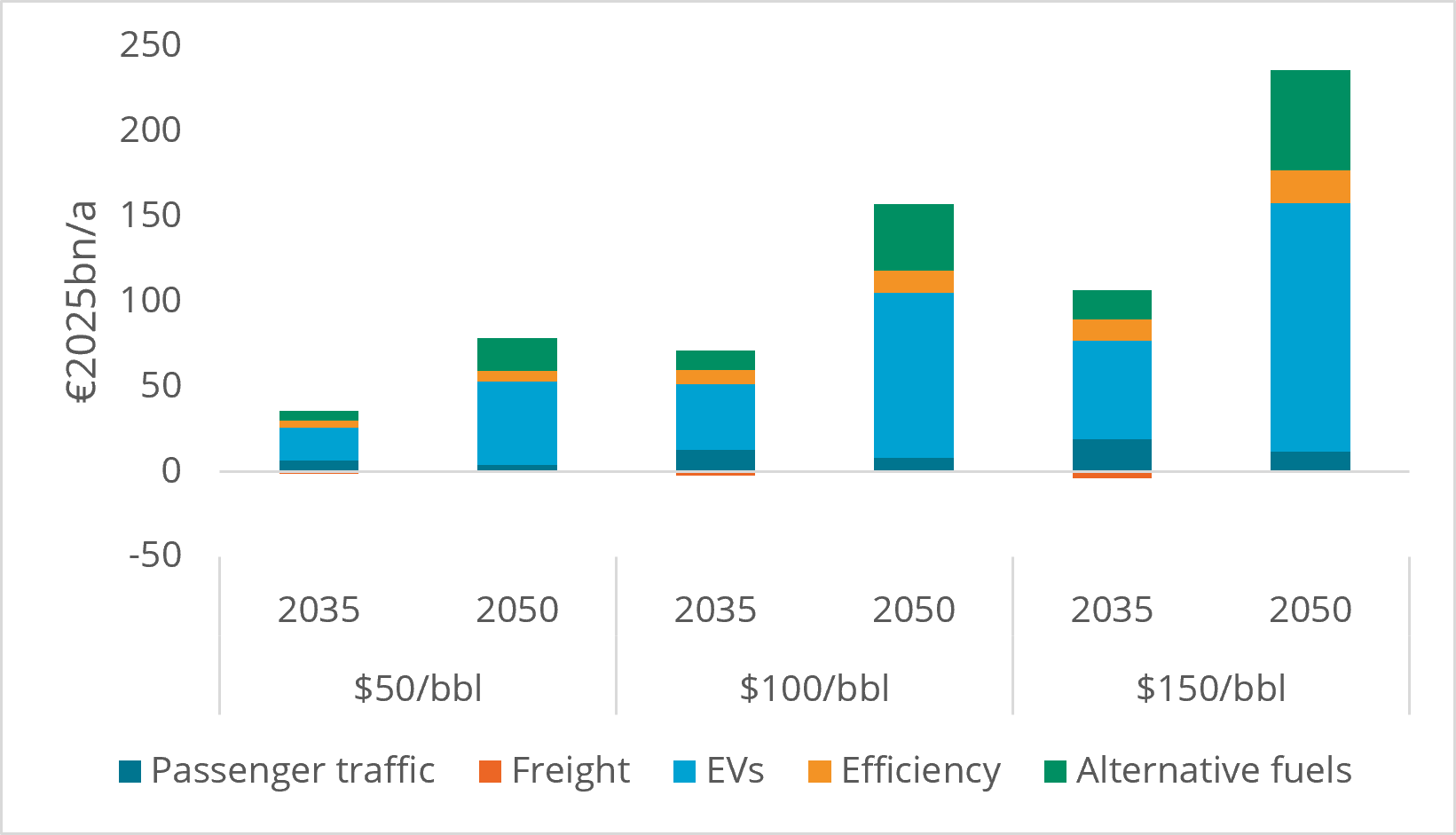
Looking more specifically at road transport, we studied how these levers can directly bolster European energy security and help reduce its imports. Although electric vehicles are scaling rapidly, electricity still accounted for only 3% of the EU's transport energy consumption in 2025. Moving forward, increasing the share of EVs in light vehicle fleets is the most powerful mechanism to cut Europe's dependency on foreign oil. Under the EnerBlue and EnerGreen scenarios, the share of EVs in light electric vehicles reaches 40% and 50% respectively as early as 2035, and accounts for virtually all light vehicles by 2050. Switching to alternative fuels is also a key driver in reducing oil consumption especially in heavy vehicles transport. Finally, traffic reduction through behavioural changes inducing e.g. modal shifts and car-pooling could have a significant contribution as well.
This transition is projected to avoid millions of imported oil barrels, significantly limiting the region's exposure to geopolitical supply disruptions and volatile global crude markets. In 2050, these savings could amount to between €80bn and €236bn per year of avoided barrels of crude equivalent, depending on the average barrel price. To put that in perspective, total EU imports in 2025 amounted to $2500bn.
Powering Growth, Not Emissions
Global growth returns to pre-crisis patterns—but emissions are not decreasing fast enough for climate goals. As renewables surge and electricity demand accelerates, fossil fuels remain dominant. Discover the key trends reshaping energy and decarbonisation across the G20 in 2025.
Download the publication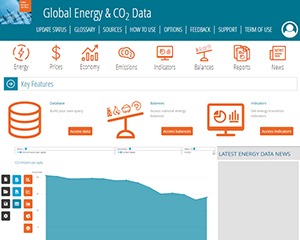
Access to the most comprehensive and up-to-date database on energy supply, demand, prices and GHG emissions (186 countries).
- Comprehensive
- Annual energy and GHG data from 1990 onwards
- Up to 2000+ data series and indicators by country per year
- Coverage of all energies in 186 countries
- Reliable
- 30-year experience in energy balances and statistics
- Data and indicators compliant with the best international norms
Copyright © Enerdata 2009 - 2026 All rights reserved - Terms and Conditions - Cookies management
The Enerdata Yearbook is a proprietary application. Neither the Yearbook nor its integrated data set (be it in the form of raw data or derived data) shall be distributed, published, or sold.


